Table of Contents
(?)
A Random Photo (?)
Brest Regional Museum
|
After the retreat of the Germans, the inhabitants returned to the city, but due to the skirmishes between the Bolsheviks and the Poles there was a delay in their return. In the 1921 census only about half of the inhabitants among them the Jews took part. From 1919 the number of Poles who settled in Brest grew. Brest later became the capital Veiboriyut [?] of Polesia district, the number of Brest's inhabitants grew even more.
Politics
Between 1922 and 1925 there was in Brest a branch of the The Interim National Jewish Committee in Poland whose founder and leader was Yitzchak Grunboim. Until 1926 there was in Brest a nominated municipal council with more then 20 members. Although its exact composition is not known, one can assume that there were some Jewish representatives as well. On June 27th 1926 elections were held and among 31 committee members; 17 Jews were elected. These Jewish representatives belonged to the following political parties: Religious: 5; Left: 4; Economic Organizations: 5. But the results were nullified by the district governor and on September 19th 1926 new elections were held. This time only 14 Jews, out of the 31 members, were elected. Their affiliations were as follows:
Affiliation
Seats
Religious
3
Orthodox
2
House-owners
1
Merchants
2
Artisans
3
Workers-of-Zion Right [Faction]
1
Workers-of-Zion Left [Faction]
1
The Bund
2
[Page 233]
A Pole, Thomas Zalon, was elected as Mayor. He was a socialist who had good relations with the Jewish representatives. Dr. B. Vilner was elected as his deputy and after his death Dr. Avraham Levinson was elected. Two Jews were elected to the city management out of its four members. This municipality was dispersed in May 1928 and on June 17th of the same year new elections were held. About half of the voters were Jews, 9,588 out of 18,945. This time 19 Jews were elected out of 30 members of the committee. Thomas Zalon was reelected Mayor and Dr. Avraham Levinson was reelected as the deputy mayor. Two Jews were again chosen for the city administration (Magistrate). In September 1930 additional elections were held for the city council but this time the Jewish representation went down to 11:
| Workers-of-Zion Left [Faction] |
2 |
| Workers-of-Zion [Faction] |
1 |
| Baley Batim (Home Owners |
1 |
| Non-Party Merchants |
1 |
| Artisans |
2 |
| Financial Union |
1 |
| Mizrachi |
2 |
| Orthodox |
1 |
The deputy mayor was once again Abraham Levinson, but this time only one Jew was elected to the city administration. The county Governor delayed his approval of the appointments by almost a year. During the second half of the 1930's, the Jewish representation went down to only 9 out of 30, but the deputy mayor was still Jewish - Yechiel Mastboim. The city administration had only one Jewish member (out of 4).
The Jewish members did not always vote unanimously but most of the time they worked together. Sometimes the left-winged members --Workers-of-Zion Left [Faction] and Bund-- preferred voting alongside the Gentile socialists, for instance, when the subject of the vote upon was purely a social matter.
The Jewish representatives fought for the employment of Jewish workers and clerks in the municipality and for the right to give speeches in Yiddish and to include Yiddish in the municipal publications. They fought for the equal budgeting of the Jewish educational and charity institutions. Of their many accomplishments two noteworthy ones were: Naming a street after Y. L. Peretz, and founding a Yiddish/Hebrew section in the municipal library.
The budget battle was usually lost due to the Governor's opposition.
From the middle of the 1930's there began a steady decline in the budgets forwarded to Jewish causes, till they were terminated completely.
In 1928 the city council and the Governor battled over 18,000 'gold coins'. The Jewish representatives claimed that the Jewish institutions are in terrible shape because they were being discriminated against. Since the city budget was in deficit, the Jews suggested that these institutions would be financed through an additional budget, an act that required the Governor's agreement, which he refused to grant.
Only after intensive pressure was he willing to grant the money in the form of bonds [?]. The distribution of this budget was:
Education- 4,600
Orphanage- 3,285
Adoption- 2,915 The Findel Dormitory- 1,315 Ort- 1,642 Tau- 1,314 Linat Tzedek (Sleeping Justice) - 920 Moshav Zkenim (The seating of the Elders) - 970.
In the Budget of 1929/1930 83,700 'gold coins' were included for the Jewish institutions, i.e. a growth of over 100% compared to the previous year. The main sections were:
Orphans- 28,200
Jewish Education- 22,500
The Jewish Hospital- 15,000 Moshav Zkenim- 8,000 Ort- 6,000 Tau- 2,000 Linat Tzedek- 2,000
It is probable that the Governor did not approve these budgets since in the 1931/1932 budget, for instance, alongside other cut backs; all of the Jewish institutional budgets were wiped out. It should be mentioned that at that time about 80% of the city's tax revenues came from the Jews. In 1938 the budget was approved at about 1.6 million 'gold coins'. Of that, 10% were supposed to go to Jewish institutions, meaning around 150,000 gold coins. After the Governor cut back more than one half of that sum, the Jewish institutions received a little over 10,000 gold coins.
Right after the exiles returned they elected a communal committee, which later on received the approval of the Polish government. As Head of the Council was elected a man of the Religious party, a friend [relative?] of Rabbi Yitzchak Zeev Soloveitchik.
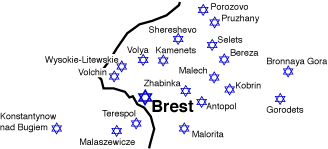
In the first elections for the committee, which were to be held on September 9th, 1928 the Jews of Malorita and Charnbechicha were joined to Brest-Litovsk. 15 lists of candidates were submitted, and out of these, 20 people were chosen.
The division was: Achdut (Union) - 8 Mizrachi - 2
Artisans - 2 Zablud (Artisans) - 2
Workers-of-Zion Left [Faction] - 2
Workers-of-Zion Right [Faction] - 1
Bund - 1
Civil List - 1 Small Merchants- 1
For the community administration was chosen: 4 Orthodox, 2 Zionists, 2 Bond, 2 Workers-of-Zion Left [Faction] 1 Small Merchants and 1 Artisans.
As head of the community was elected an Orthodox. As a result of the diversity and the lack of a majority for the Orthodox, the community became a battlefield between the different factors and was mostly inactive [ineffective?]. The committee and administration met once a year mainly to approve the budget. In 1935 elections were held again and this time the committee and administration were more representing. The administration met 2-3 times a week, fought a fierce battle against anti-Semitism and took part in the activity regarding Kosher slaughter and even financed the meat branch workers that suffered.
[Page 234]
The Pogrom of 1937
The community council wasalso involved in [instrumental in combatting?] the pogrom that took place against the Jews of the city on May 13, 1937, during which the rioters stole, with the help of the police, from Jewish stores and beat the Jews. Deputy Mayor Yehiel Mastbaum appealed to the regional governor's office and requested aid, but there wasn't any response. Also his appeal and the appeals of the community leaders were rebuffed. Only after an appeal by telephone to the government in Warsaw was there given an order to the police to put an end to the pogrom, and even though by evening the police intervened, there was great financial damage. With the community's initiative a committee was set up to aid the victims. In 1929 Rabbi Yitzhak Ze'ev Soloveitchik was chosen as the community's rabbi, and he held this position until September 1939.
|
|