|
|
|
| This shield was used from
the 16th Century until the city came under Russian rule in the
19th Century. During Russian rule the original shield was
replaced with the bison shield to the right. This symbol has now been restored to use and now can be seen in numerous places in modern Brest. |
The bison (zubr) was a once very numerous animal in the
region. Bierascie, as
Brest was known, was an important border city for Russia; this is recognized by Russian eagle flag on the lower port of this Russian-era shield. |
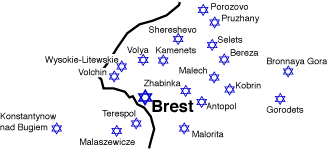
The City of Brest (Latitude: 52.06N - Longitude:
23.42E) is in the western part of Belarus, also known as Belorussian Polessye (Polesie). The
current population is approximately 300,000. The city is
situated at the junction of the Mukhavets River and the
Western Bug River. Brest is the administrative center of the Brest Region.
Over the centuries Brest has been peopled by people of many origins and has had many different names: -- Yiddish: Brisk or Brisk D'lita (Brest of Lithuania*).
-- Russian: Brest-Litovsk: Brest of
Lithuania*. Also known as Brestye, Berestye, Berestei, Berestov.
-- Polish: Brzesc, Brzesc nad Bugiem (Brest on the River Bug), Brzesc-Litevski*
-- Belarusian: Brest, Brest Litousk*
-- Ukrainian: Berestia
-- Lithuanian: Brastas
-- German: Brest-Litowsk*
The name is said to be derived from the
word Berestye, birch-bark.
* D'lita, Litovsk, Litevski, Litousk, Litowsk all signify Lithuania, but these do not refer to the modern nation of that name. Rather, these words refers to the Grand Duchy of Lithuania (often abbreviated GDL) which encompassed the entire region in the 14th century.
Jews have lived in Brest since as early as 1388, when the Grand Duke Vitautas of Lithuania granted a charter to the Jews living in the town.
The presence of Jews is well-documented since 1503. Since those early days there was always a Jewish cemetery in Brest.
The Jews from
Brest called themselves Brisker. The Brisker Jews also refer to themselves
as Litvish - or Litvaks, again referring to the 14th century Grand Duchy of Lithuania.
1556 - Jewish house owners in Brest numbered 106
(12.4%), in a total population of 852. The houses were small,
insignificant frame buildings. The only synagogue was also a frame
building.
1566 - Jewish house owners in Brest numbered 85.
1776 - The Jewish population of Brest was 3,175.
1862 - The total population of Brest was 20,000.
1882 - The total population of Brest was 35,000.
1887 - The total population of Brest was 44,124.
1897 - The Jewish population of Brest city was 30,252
(65%), in a total population of 46,568 (25,509 men and 21,059 women).
1897 - The Jewish population of Brest district
(including the city) was 45,902 (21%), in a total population of 218,366.
1909 - The population of Brest city (mainly Jewish)
had increased to 53,000.
1981 - The population of Brest city was estimated at
194,000.
1983 - The population of Brest city was estimated at
286,400.
1992 - The population of Brest city was estimated at
284,086.
1996 - The population of Brest city was estimated at
293,086.
A Town with Four Names, by Dr. Sam Chani
|