Table of Contents
(?)
A Random Photo (?)
sam 28
|
 |
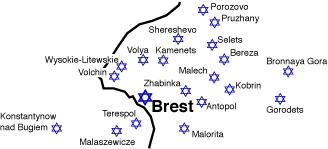
Kamenets is about 40 km (25 mi) north-east of Brest
Map: Based on inter-war Wojskowy Instytut Geograficzny 300K scale maps, courtesy of mapywig.org
|
 |
A small portion of a 1:100k scale 1930's Polish military map,
courtesy of mapywig.org |
Kamenets is located in Brest Region of Belarus, near what is current City of Brest, Belarus. The population in 2002 was estimated at 6000 to 9000. In 1925 there was estimated to be a population of 4,000, 80% Jewish.
The name derives from the word kameny -- stony. Name variants: Kamieniec Litewski, Kmenets-Litovskiy, Kamenets-Litovsk, Kamenets-Litevski, Kamenets-Litevske, Kamenets-Litovskiy, Kamyanyets
Kamenets History
The city was mentioned for the first time in the old Russian chronicles in the late 13th century when a castle with the famous tower of Kamenets was constructed (about 1276) to protect Brest-Litovsk and the northern boundary of Volyn's principality from the Tartar invaders.
The advantageous location of the castle, on the stony steep banks of the Lesnaya (Lesna) River was found by Aleksa, the prominent builder and architect in Volyn principality. By the order of Prince Volyn Vladimir Vasilkovich, the prince of Volyn, he built several castles, including that in Brest (Berestye).
It is believed that the last Jewish person to be living in Kamenets was Schlomo Kantorovich, who died in the late 1990's. He was married to a non-Jewish woman. They had 2 daughters and one grandson. Schlomo lived in a Town near to Kamenets before the war, and fled when the Nazis sent all the Jewish people to concentration camps. He was a soldier in the Russian Army and received 16 medals in battles from Moscow to Berlin. After the war he worked as an accountant.
The fortress was called the White Tower (Polish: Biala Wieza), as it was formerly covered with a white surface.
According to this Wikipedia article: The castle was built as an enclosed community. Like many European castles, it had a great round tower, on the raised mound (motte), surrounded by a moat on 3 sides and the river, an adjoining enclosure (bailey). This type of the motte and bailey castle appeared in the 10th and 11th centuries between the Rhine and Loire rivers and eventually spread to most of western Europe and even to the area of the present Belarus. The red-brick tower with guard and residential rooms on 5 levels was actually a donjon or a keep, that was quite common in France and England till the 16th century. It is 30 m high, the walls are about 2.5 m thick, 14 battlements at the top and a pitched roof.
The windows on lower levels were narrow, looked like loopholes with lancet arches. The pointed lancet windows on the upper 5th level were bigger and the openings were once plastered and whitewashed. The upper part of the tower was furnished with battlements and several nice courses of brickwork, once the niches resembling window openings were plastered and whitewashed. From the 13th century until the 17th century the castle was assulted many times and remained unconquered.
According to the Spiritus-Temporis website: At one time, similar towers were built in Brest (Berestye), Grodno, Turov and Novogrudok, but they were destroyed in the course of wars. The tower of Kamenets is the only survivor.
Some Kamenetzers
Yekheskl (Ezekiel) Kotik (1847-1921), was born in Kamenets-Litovsk. He is mainly known for his two-volume memoirs Mayne Zikhroyne (1913-1914). Kotik describes his childhood in Kamenets in the first volume. The second volume covers his life elsewhere in Eastern Europe and Russia.
The late Miguel Kaplansky of Argentina visited his beloved family home, Kamenets, in 1991. Miguel was accompanied by Scholomo Kantorowich. Miguel's guide was Eugeny Polischuk.
A Description of pre-1900 Kamenets
In The Village of Zastavia Y. Kotik describes Kamenets from the viewpoint of the neighboring village of Zastavia, across the Lesna River:
Directly opposite Zastavia, on the other side of the bridge, over the River Leshno, stood the City of Kamenetz-Litovsk, which was built on a steep hill upon which were clustered houses big and small, so that from a distance you would think that one stood on top of the other, that one was supported by the roof of a second. As though they held to each other in fear of falling (God forbid) into the deep abyss below.
This neighboring town, Kamenetz-Litovsk, which was so near that one might almost stretch his hand out to reach it, looked to the small-town Zastavia as the it were a really, really big city, something that belonged to a different world, from which we villagers shrunk back in awe.
Kamenetz was known as a city with learned scholars and students of wisdom. It posessed a dozen Houses of Study, among them a well-known, large and beautiful synagogue, which was something to be proud of; a children’s school for the education of the poor; a rabbinical college for local and visiting yeshiva-students; two cemeteries, an old and a large new one, which served the whole region with eternal peace .
Kamenetz was also known throughout the region for its old, historical walled tower, which with its size and height, reminded one of the Tower of Babel. According to old legends, it was built by a long-ago Lithuanian duke. And so that it should be strong as a rock and remain standing for ever and ever, they made the mortar with egg-yolks instead of water. And so it was indeed as strong as a fortress and its pointed tower seemed to reach all the way to the sky. Flocks of black crows used to take shelter on its walls and ledges giving it an eerie atmosphere. With their endless crowing through the dark nights they cast a terror among the surrounding neighbors, as though in truth they were not really crows at all, but lost, sinful souls, assuming the form of these black, ugly creatures....
|
|
|
|
|
Kamenets White Tower
|
Kamenets White Tower
|
Kamenets White Tower
|
|
|
|
|
|
Drawing of Castle of Kamenets
Photo Credit: Yogi555
|
Kamenets White Tower
|
The tower of Kamenets in 1899 -
Photo Credit: yogi555 |
| |
 |
|
| |
Former Kamenets Synagogue, 2002.
The structure is now an administrative building.
Photo Credit: Yuri Dorn |
|
JewishGen's English Translation of the Kamenets Yizkor Book
Brest Region Guide Kamenets page (Russian)
Belarus Guide Kamenets page (English)
|
|