Betty Fagenson Lewis was born in Wysokie-Litovsk. Her mother was Fruma Matl Feigensohn.
This picture was taken in Wysokie-Litovsk in August, 1910. Dr. Berens thinks that her grandmother wanted to leave a photo of herself and her children with her mother-in law, Bubba Gittel who was not going to the United States
In August of 2005, Dr. Gloria Berens of New York, USA, Betty Fagenson Lewis' daughter, gave us written permission to post this story here. Headings added for reference purposes by the webmaster.
 |
Fruma Matl Feigensohn |
46 |
Rear row |
Center |
| Hannah (Anna) |
12 |
Rear row |
Left |
| Shaineh (Jennie) |
10 |
Rear row |
Right |
| Rivkah (Betty) |
7 |
Front row |
Left |
| Faygele (Fay) |
8 |
Front row |
Right |
I was born on April 14, 1903. My mother was 39 years old and had already borne four other children, all girls. My mother had married late - she was 25 when she married. Apparently there were not many prospects for marriage in the village where she lived.
Mother had lost her oldest child in 1900 and sometimes talked about the child - Razel - who died of a ruptured appendix. There was some epidemic that had occurred in a nearby town, and all the doctors - maybe there was only one doctor in the shtetl - had gone to attend to the sick in the other town. There was no one to operate on Razel.
About Wisoko-Litovsk
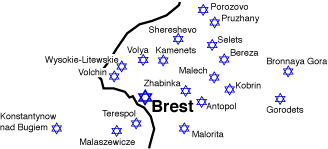
The shtetl where I was born was Wisoko-Litovsk, (sometimes spelled Visoke-Litovske, depending upon what map or what atlas you consult) a village on the outskirts of Bialystok. [Editor's note: I have consulted a map showing both location and the distance between them is approximately 40 kilometers (25 miles), Wisoko-Litovsk lying south of Bialystok. However, the fact that my mother indicates an incorrect proximity suggests that people in Wisoko-Litovsk thought of Bialystok as the closest large city, rather than Brest-Litovsk, which was much closer than Bialystok].
Wisoko-Litovsk was an agricultural village rather than an industrial one although there was a sawmill, and, I think, a leather industry. It was not an altogether poor setting. There were some who had money. We, however, were very poor, and my mother had to provide some income. I don't think that my father earned a living, certainly not enough to sustain a family with four children. But at least we had a house, the very same house my mother and my maternal grandmother had been born in. Half of the house belonged to us and the other half to my mother's aunt - my grandmother's sister. So the two families lived in this house.
My Father
My father was also born in Wisoko-Litovsk, probably about the same time that my mother was born. His family had also lived in the village for generations. Apparently, he and my grandmother had grown up together and must have known each other as children, although they never spoke of it during their lifetime. In Europe, people never indulged in sharing reminiscences, or even current happenings with their children. I don't know whether they ever played together, because the character of the village was primarily religious in structure and the emphasis was on learning. As a youngster growing up, my father only wanted to learn Torah. He wasn't motivated to work and to contribute financially to his family. There were those like his older brother who left Wisoko-Litovsk to go to the bigger city, Bialystok, to further their secular education. He had no ambition or desire to leave for a big city. He wanted to be near home and to study Torah. That was not totally acceptable to the family, and from time to time, he found odd jobs to contribute to the home. For example, there was a leather factory in Wisoko-Litovsk, and it was a necessary process to soften the hides. My father was involved in bringing the hides to the river to be softened. It seems to me that the turning point in my father's outlook came about when he was compelled to enter the Polish army. It must have been quite a change for him to endure the hardships of military life, to leave his books and a less disciplined life, and to assume military responsibility. He was in the army for four years.
Marriages
The main reason my mother had married my father was that her mother feared her becoming an old maid. After all, she was already 25 when she married, and that was considered old. The marriage to my father was a shiddach (an arranged marriage) made by my paternal grandmother after my father came out of the army. From what I understand, my maternal grandfather was a man of law and order. They both treated their children with an iron hand.
My mother always told the story about making a shiddach for her brother. The match maker came with the aunt and the prospective bride to my grandmother's house. The family had to check to see if the bride would do, would be suitable for their son. They were all sitting around, and the aunt started cutting up her clothes and wrapping the pieces of cloth around her finger. When the prospective groom heard about the mishigina (crazy one), he said that he didn't want to get into a mishigina family, and shortly thereafter, left for America.
My Grandparents
My grandfather must have been a carpenter in his early years, but developed into a skilled craftsman, a wood sculptor. He would go to the different towns and cities, to the synagogue to do wood carving - pictures and images - and would then color them. He would be away for periods of time. He had expanded his horizons in moving out of the shtetl, going from village to village and town to town. He first carved the doors of the Ark where the Torah rests, in Wisoko-Litovsk, and went on to other villages as his reputation spread. My mother spoke proudly of his work as an artist. I don't remember either of my maternal grand parents.
I do know that my paternal grand parents were alive when I was born, and I have clear memories of my paternal grandmother, Gittel. She worked as a civil servant, as a letter carrier, delivering mail throughout the village. It seems to me that she was unique for that period. I don't think that women were given responsible positions at that time. She was married to Srolkeh (a diminutive form of the name Israel); he was a determined individual in the European tradition, where the father was the provider of the home and his word was law. And again, this marriage between Gittel and Srolkeh was a shiddach - there was no other way of meeting anyone.
It seems to me that my grandmother, Gittel, must have been the provider of the home. My mother talked about Srolkeh as a bench-warmer. But, at the same time, Srolkeh must have been a scholar, studying Torah. The tradition of learning ran very deep in my father's family. It was very important to my grandmother, Gittel, that my sisters and I get an education, and so she took on a second job during our childhood, working in a bakery. She would deliver buckwheat pancakes, made at the bakery, from door to door, early in the morning. I remember my sisters and me up in the alcove in the early morning, warming ourselves, when Bubba Gittel rushed in with her bundle of buckwheat cakes and potatoniks. Kindelach, kum arunter (Translation: Children --an endearing form of kinder-- come down.) We all rushed and tumbled down and ran for our share. I always reacted with joy and glee to her call. In Wisoko-Litovsk, I was most attached to Bubba Gittel. My mother and Gittel got along very well. There was a closeness between them. She was very helpful in our development. My father had gone off to America when I was two and Gittel, as I see it now, was a major support for my mother, in my father's absence. In fact, my mother wanted Gittel to come with us to America. Gittel was already 75 at that time, and said that she was too old and couldn't get used to another medineh (Yiddish word for country).
My Mother
My mother was a witch and she practiced witchcraft. Mysticism was the rule in our house. When she wanted to find out what was holding back the mail from Papa [Editors note: my grandfather was already in the US.], she would take out the baker's sifter, a sieve, a large round strainer, with a wood frame - before the mail was delivered. She would hold the sifter in a horizontal position and would place and open a pair of scissors to its capacity and dig each pointed tip into the wood on either side of the wood frame. The scissors would be held by two people lightly, each one holding on to one side of the scissors. Somehow or other, at times the sifter would revolve by itself. My mother at these times would attribute the movement to the coming of a letter from my father. Bubba Gittel would hold one side and my mother would hold the other side. My mother would say, Faygele, Faygele, vee dem taten? Dem taten vill shicken a brivele? Vill zehn a brivele frim dem taten? (Little bird, little bird, where is father? Will father send a letter? Will we see a letter from father?) Invariably, if the sieve moved, a letter from Papa would appear within the next few days.
My mother was a folk doctor in Wisoko-Litovsk. People would come to her to have their throats swabbed and to have their chests and backs cupped and other witcheries to make them well when they were ill. (The process of cupping was known as Shtellen Banckes - this was a process in which the inside of small glass cups, about 1 1/2 inches in diameter and about 2 inches high were swabbed with alcohol; then a lit match was inserted within the cup and a vacuum created; then the cup was immediately put on the bare skin of the chest or back. The number of cups used depended upon the size of the area needing treatment). There was probably only one doctor throughout the entire village, and the people were forced to resort to witchcraft and folk medicine. My mother never used leeches although some people used these blood-suckers. If you had a cut or an infection, mother would gather the moldy residues from every crack in the wall and wrap it, wind it around the area of infection. In two days, it would be healed. It was called Poltava. In America, when we had a cold or if we didn't feel well, we got banckes.
In Wisoko-Litovsk, my mother would accompany her aunt (her father's sister) to deliver babies, and although she herself, at that time didn't do it, she observed and probably helped her aunt, and so she became proficient at delivery. Also, my mother always wore a large white apron. When some sick person came to her, my mother would take the ends of the apron and make accordion pleats, then take the mass of pleats and revolve them around the head of an afflicted person. This was supposed to drive out the evil spirits. (Editor's note: As a child in New York, I can remember my grandmother, with her apron's accordion pleats carefully folded, revolving that apron around my head, to help me get rid of an eye inflammation!)
In Wisoke-Litovsk, my mother had good relations with the non-Jewish population. First of all, she worked for them. Second of all, she believed that it didn't pay to be on bad terms with Goyim (non-Jews) - you had to get along with them.
When you were born, they put a little red ribbon to keep away the evil eye. Nidugedacht! (Don't even think it.); Nisht fahr diehr gedacht! (Literally: Not to be thought of in terms of you, but connotatively, It shouldn't happen to you!); Nisht fahr unzerer kinder gedacht! (Literally, Not to be thought of in terms of our children, but again, connotatively, It shouldn't happen to our children!) All this was said in referring to the evil eye, a superstitious belief that something bad is going to happen to you.
I remember Friday
I don't remember too much about Wisoko-Litovsk. What I do remember is on Friday nights, the town crier would go throughout the village calling out, In Shul arein! In Shul arein! Benchin licht! Benchin licht! (Translation: Into the synagogue! Light candles and pray!), and everyone would tie up all the small ends that they were involved in, say the prayers over the candle lights, and dress to go to the synagogue to pray. The children didn't go along. I remember a story --a mysticism of my mother's-- that my mother told, that when you leave the synagogue, the dead come there at midnight to pray. She told how, one night, a lost traveler seeing a light in the distance, followed it and it led him to the shul(synagogue). He was frightened to see all the dead people praying. This story aroused fear within us. There was always, on Friday nights, a time when we children sat around before my mother bencht licht -- prayed over the lit Sabbath candles-- and we would drink chai, (Russian word for tea) from a saucer. They poured the tea into a cup and we then poured it into a saucer. We'd get hard pieces of sugar. You'd bite into the sugar and sip tea. We all sat around the samovar sipping tea and munching sugar.
Every Friday was a very exciting day. Everyone in the shtetl would be preparing food for Saturday, baking cakes and challahs and preparing the chunt. (Chunt: a one-pot meal consisting of meat, potatoes, beans and stuffing that is cooked overnight on Fridays in a low -temperature oven, and eaten when the family returns from synagogue on Saturday. Among religious Jews, it is forbidden to cook on the Sabbath,which starts on Friday night). My mother would make kreplach (similar to Chinese Won Ton) and Gefilte fish and Tzimmes and flumen carrots and prunes) with potatoes, and a chunk of beef. On holidays, everyone would be busy cooking and baking - it was very festive; everyone visited everyone else.
Passover
Before Pesach (Passover), they washed the pots. They would heat an iron to smoking hot and put it into the pot. The heat from the iron was supposed to burn out the Khometz (any residue of leavened material, such as leavened dough, strictly forbidden on Passover). And, there was special treatment for the silverware: if they used Khometzdickeh silverware (silverware used all year round and therefore in contact with leavened material), they had to keep it in water for six days. If you wanted to make any eating or cooking utensil Pesadiche(usable during Passover), you had to bury it in the ground for five days.
Rosh Hashanah
Rosh Hashanah was a serious time - the climate was one of fear. They were afraid because, at that time, it was a question of living or dying. (According to the Jewish religion, this is the time when God decides who is to live or die for the coming year). At Rosh Hashanah, it was the fear of God's wrath turning against you because you had sinned. And you never knew whether you had sinned or not, and what your punishment would be. It was a time of great anxiety for everyone. Many behaviors were considered sinful like doing something on a Saturday that you weren't supposed to do, or having sex on Rosh Hashanah or Yom Kippur. You had to pray for special forgiveness from God if you had sinned - because you were a Mahashefe -- a malicious, wicked woman.
Shabbat
On Shabbat we were not allowed to do anything, so we would put on pretty little dresses and go walking to the river. Everyone in the shtetl would walk to the river. During the summer months, we would walk through the fields of high grass which led to the river, where we would undress and bathe, naked. This was the custom of many families -- to go on a hot summer's morning to the river to bathe.
To America
When I was 2, my father left for America. Families in the village were taking leave for America. The cry was that gold was found in the streets, Die Goldeneh Medineh: The Country of Gold. Beyond that, it was rumored that Russia and Japan were going to war and my father expected and feared being called into the army - he was in the reserve, after all. So, off he went to America.
In 1910, after being without his family for 5 years, my father decided to send for us. He sent us tickets for the ship. There was a lot of excitement in our house. I was too young to understand what was going on. I remember that my mother bought us all new rubbers and I loved the smell of those rubbers. I can conjure up the smell of them, still! I remember the villagers coming to wish us well and to see us off. I was worried, with all the people coming and going, that someone might take my rubbers. I would run over to where my rubbers lay, pick them up and smell them, and hold on to them. I wanted to take them out and wear them, but I was afraid that my mother would catch me. They were stored in my mother's bedroom and I would steal in there. But invariably, my mother would follow me in, asking, What are you doing there? Why don't you listen to me? And she would give me a potch (Yiddish for slap) on my backside.
Before we left, there was much baking going on. My mother baked Tzikarkha -- Zwieback -- to take along with us on the trip. And we all dressed up one day to go to the photographer's to take pictures - my mother with her sheitel --a wig worn by religious Jewish women to conceal their hair-- dressed in all her finery, and we four children.
My mother was busy packing our belongings -- bedgevant (bedding), pillows, perenhe - a feather-bed quilt. She had bought goose down and for weeks before we left, we were all picking out the quills from the goose feathers. The whole family worked to make a feather-bed quilt. There were also linens that were sent, crocheted table cloths, tablecloths embroidered with my mother's initials, M.F., four large candlesticks and a small candlestick, a mortar and pestle called Shtaysel (Stoessel in German), prayer books, and a Samovar. It was a sad feeling leaving my Bubba Gittel. I was very attached to her and I remember running over to her and yanking on her apron while she patted my head.
We left Wisoko-Litovsk in the morning on an August day in 1910. Two droshkes came for us. My mother was bringing two other children, family members, whose parents were already in the U.S. A droshke is a horse-drawn carriage. The droshkes took us to the Bahn - the train station. And we said goodbye to Wisoke-Litovsk.
|