Jewish Brest-Litovsk (Brisk) - Your Virtual Shtetl
History - Years 1800 to 1899 - Page

Volunteers Needed!
We need volunteers to work on this web site. No web building (HTML coding) knowledge is required. The work will be mostly research. Contact the webmaster of this web site by clicking here.


Research Projects
Research Aids
Belarus URL Links

Geographical Pages
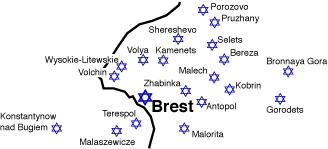
Shtetls Close To Brest Pages
Name Pages
Brisker Organization Pages
Workmen's Circle, Brisker Branch #286, New York
Brisker Bnai Brith K. U. V.
Brisk D'lita Lodge IOBA
Brisker Aid Society
Brisker Ladies Benevolent Association
Independent Brisk United Verein
Brisker Branch 15 JPFO
Brisker Shul Tifereth Israel
Brisker Shul Newark NJ
Brisker Shul New York NY
Brisker-Ciechanowcer Branch 15 IWO
Independent Brisk Young Men
Brest-Litovsk Province Aid Society
United Brisk Benevolent Society
United Brisk Relief New York City
United Brisk Relief New Jersey
Brisker Grodner Cleveland
Brisker Unterstuestzungs Verein

Briskers Pages
Elderly of Brest NEW
Menachem Begin NEW
Arkady Blacher NEW
Betty Fagenson Lewis NEW
Harry Rosenberg NEW
Sara Sanditen
Andrea Simon NEW
Shleyma Weinstein

Informational Pages


NOTICE
Free service
If you are interested in being notified when this page is updated, all you need do is fill in your e-mail address and you will automatically receive notification via e-mail.

Monitor page
for changes
    
   it's private  

ChangeDetection


e-mail Gif

History of Brest
Because of its border location the city often was in the center of military actions and it changed hands very frequently.

Here is the chronology of various events and facts in the history of what is called today Brest, Belarus and the surrounding region. Where appropriate the history of Russia, Poland and Lithuania are included. It gives you the opportunity to picture the most important events in the history of the region, their order, and influence to development of the region.

Current day Brest, Belarus has been conquered, occupied, taken over or annexed by many different countries over the years. Some of them were the Slavic Tribes, Old Russian State, Lithuania, Poland, Mongols, Tartars, Russia, France, Germany and today Belarus.

Current day Brest, Belarus has had many different names depending upon who occupied the area. Some of the names used in the below History are Bereste, Bierascie, Brestye, Brest-Litovsk, Brest, Brzesc, Brzesc nad Bugiem (Brest on River Bug) and Brisk.

Among these events there was sad and glad ones, heroic triumphs and defeats, people's tears and jubilations, facts of creation and destruction.

You can find here the information about the most important political events, wars and armistices, rebellions and revolutions, periods of reign, and so on, and so forth. All this information is placed here in chronological order and sorted by centuries.

All of the pictures, maps and illustrations can be clicked on, and they will be enlarged.


CLICK BELOW TO JUMP TO A SPECIFIC CENTURY

11th - 12th - 13th - 14th - 15th - 16th - 17th - 18th - 19th - 20th - 21st

19th CENTURY

  • 1801 September 21 - Grodno gubernia was created. It included all the territory of modern Brest region and existed up to 1921. Brest (called Brest-Litovsk) was made a district town of the government of Grodno.
  • 1801 - 1825 March 24 - Tsar Alexander I (The Blessed) reigned in Russia.He Alexander did a lot of good to improve the administration of his massive empire.
  • 1802 Brest had a large part of the Jewish quarters destroyed by a fire. ABout 160 houses were burnt in the town center. This is mentioned in Pamyat (Memory) volume 1
  • 1802 September 21 - Grodno gubernia was created. It included all the territory of modern Brest region and existed up to 1921. Brest was made a district town of the government of Grodno.
  • 1804 In Brest-Litovsk a rabbi who officiated was Joseph ben Abraham Katzenellenbogen (Katzenelenbogen).
  • 1804 Tsar Alexander I, in his "Statute Concerning the Organization of the Jews" is the first to formulate the dual policy of forced assimilation and expulsion from the villages. With the aim to draw the Jews into the general stream of economic and cultural life, Jews may now enter public schools for the first time. In order to undermine the Jewish village economy, Jewish residence in the villages is prohibited, and expulsions begin soon afterward. Jews are also forbidden to distill or sell alcohol to peasants, or continue leasing activities in the villages.
  • 1804 circa In Brest-Litovsk a rabbi who officiated was Na?man Heilprin.
  • 1811 Czar considers cultural independence for Belarus nobles to counter appeal of Napoleon.
  • 1812 Belarus became the main arena of military activities, during the war of Russia with Napoleon.
  • 1812 June 23 - Almost all of Europe was under Napoleon's control, and the invasion of Russia was an attempt to force Czar Alexander I to submit once again to the terms of a treaty Napoleon had imposed upon him four years earlier. All of Napoleon's troops had taken their positions. Napoleon's main army was between Kovno and Pilviszki. All of Napoleon's forces totaled up to 499,000 men, with 1146 guns. At this time Russia had an army of 183,000 men and 15,000 Cossacks, with 938 guns.
  • 1812 Except for aristocrats, wealthy people and the well off Jewish merchants, Jewish people did not get Surnames until Napoleon captured Russia. Then the Jewish people were ordered to get Surnames. The reason for the Surnames were for tax purposes. After Napoleon's defeat many Jews dropped their Surnames and returned to "son of" names like MENDELSOHN, JACOBSON, LEVINSON, etc. When Jews adopted family names, the choice was frequently the patronymic and first names thus became family names.
  • 1812 June 24 - The Russians retreated as Bonaparte's troops swarmed across the frontier on the River Niemen.
  • 1812 August 12 - Russian and French forces clash near Gorodechno in Pruzhany district.
  • 1812 September 7 - The battle of Borodino, was the greatest mass slaughter in the history of warfare up until 1812. Napoleon's troops suffered dreadful losses of about 35,000 men. But the Russians were so bloodied (losing about 44,000 men) that they retreated, burning Moscow on their way.
  • 1812 September 14 - The Russians had 70,000 men against Napoleon's 100,000 to defend Moscow, so the Russians finally decided to retreat. Only 25,000 people were still in Moscow when the French arrived. Napoleon's army could not be controlled, and they forced themselves into the palaces and rich houses. Some time after Napoleon's army arrived at Moscow, the Russians started setting fire to the city, eventually burning it to the ground.
  • 1812 October 3 - 10 - Parts of Napoleon's Army (Sasons and Austrians) unite at Brest.
  • 1812 October 10 - The Russian Armies led by Tormassov and Chichagov joined between Brest and Kaminiec-Litovsk.
  • 1812 October 19 - Frustrated by the loss of his prize, Moscow, and hoping for a Russian surrender that never came, Bonaparte waited in Moscow for five weeks - far too long. After Napoleon retreated from Moscow, a cold snap, coupled with the harrying tactics of the Russian Cossacks, turned the withdrawal into one of the most disastrous military manoeuvres in history. Even so, the incompetence of Russian leaders allowed Napoleon himself, and some of his hardier troops, to escape to fight another day.
  • 1812 Another French soldier, the Frenchman Puybusque, in his "Lettres sur la guerre en Russie" (Paris, 1818), supplies interesting information on the role of the Jews in the economic life of the country: “They were the intermediaries between the peasants and the lords. The lords farmed out the taverns to them and compelled them to sell only drinks made in their manors. On the occasion of festivals, baptisms, burials, marriages, the peasants were compelled to buy at least a bucket of whiskey. The Jews sold them on credit but exacted heavy interest. They intervened in all the commercial operations of the country They were also bankers.” The author relates that constant business relations linked the Polish Jews to their brothers in Germany. They had their own postal service and were informed about stock exchange quotations everywhere in Europe.
  • 1812 A French soldier who participated in the Russian campaign of Napoleon wrote a letter that shows invaluable testimony relative to the life of the Jews - “Many of them farm out and manage seignorial manors and exploit taverns. Everything is in their hands. They lend money to lords and peasants and they go to purchase merchandise at Leipzig.”
  • 1812 December 5 - Napoleon left his army to return to Paris where a coup had been foiled and to raise another army. His troops dragged themselves on and on, and finally two days later crossed the Niemen out of Russian territory. They had survived, but only 20,000 of them.
  • 1812 Brest is Bug River crossing for main transportation route from Europe to Russia.
  • 1820 The Jewish population in Russia was about 1,600,000.
  • 1822 - The big fire of 1822 destroyed the commercial part of the town - 70 houses and 150 shops. This is mentioned in Pamyat (Memory) volume 1.
  • 1825 - 1855 Tsar Nikolai the 1st reigned in Russia.
  • 1827 Jews are conscripted into the army for a period of no less than 25 years. The Jewish communities are made responsible for supplying a required number of recruits ("Cantonists") aged between 12 and 25. Kidnapping by so-called "khapers" is often necessary to fill the quota. The children are to be "re-educated," and compulsory instruction in Christian religion and physical pressure are used to induce them to convert.
  • 1828 July 27 to 28 - Brest had a fire that destroyed 220 structures (a large part of the Jewish quarters), also including the Greco-Uniate church, Brigittinian sisters' convent, 150 shops and 5 Jewish houses of prayer. The damage was estimated at 857 thousand rubles, according to the statement of the investigating commission. The Jewish Community suffered 722 thousand rubles of damage and the Christian Community 134 thousand rubles. This is mentioned in Pamyat (Memory) volume 1.
  • 1830 - 1831 November 29 - The anti-Russian rebellion began in Poland, Belarus, and Lithuania. This national liberation movement for the restoration of Rzeczpospolita was cruelly suppressed by Russia.
  • 1830 The project to build the Brest Fortress was worked out and adopted by Russian Imperial Army's military building engineers General K. Opermann (Operman), General Maletzki (Malecki) and Colonel A. Feldmann (Feldman).
  • 1831 Brest was turned into a fortress to defend the highways leading to Kyiv and Moscow from the west.
  • 1831 Population of Brest is about 10,000.
  • 1832 The ancient synagogue and historical buildings in Jewish quarter are demolished over several years, and the city is moved about two miles east to make room for the Brest Fortress. By order of Rabbi Jacob Meir Padua, a descendant of Samuel Wahl, the architect Ferdinand Schafir made a sketch of the old synagogue. This was presented Dennis Samuel of London, who was also a descendant of Samuel Wahl.
  • 1832 In the course of work on the Brest Fortress the old Jewish Cemetery was destroyed. The monuments, when removed to the new cemetery, could not be deciphered.
  • 1833 The town of Brest was moved 2 miles to the East of the old city and the building of the Brest Fortress was started.
  • 1935 A big fire destroyed most of the houses. This is mentioned in Pamyat (Memory) volume 1.
  • 1835 The ancient city of Brest was peacefully demolished and actually ceased to exist. All architectural monuments were either destroyed or reconstructed for the needs of the new masters. The inhabitants of the city could build their houses 2 miles eastwards.
  • 1835 The construction of the new town was taking place on the territory of the Volynsky, Kobrinsky and Zabugsky suburbs (fortstadts). The Kobrinsky Suburb located to the north-east of the fortress at the high bank of the Mukhavets River became the center of the new city. Invulnerable to the high waters, the site was most convenient for construction. The construction plans of the new city envisaged straight streets dividing the city into small rectangular and trapeziform quarters. Shosseinaya Street (nowadays Masherova Avenue) became the central street of the city. This differed greatly from the plans of the old city, which had radially arranged streets that started from the central city square and were crossed by semicircular streets.
  • 1835 April - The Pale of Settlement was created by a decree of Czar Nicholas 1 in April 1835. It included present day Lithuania, Belarus, Poland, Ukraine, Moldavia, and other regions west of Russia. Despite minor modifications it remained Russian policy until 1917 when the Bolshevik revolution removed it from the statute books.
  • 1836 June 1 - The first symbolic stone was laid into the foundation of the Citadel of the Brest Fortress.
  • 1836 A suspension bridge that crossed the West Bug River, near where the Fortress is being constructed, was completed. This was demolished, but no date for the demolishment is known.
  • 1837 In Brest-Litovsk a rabbi who officiated was Aryeh Lob (Arye Leib) ben Joseph Katzenellenbogen (Katzenelenbogen), he was the son of Rabbi Yosef Katzenellenbogen and grandson of Rabbi Abraham Katzenellenbogen. He died in this year.
  • 1837 In Brest-Litovsk a rabbi who officiated was Isaac ben Israel of Pinsk. He officiated until 1840.
  • 1838 In Brest, the Jewish Hospital, with 40 beds and a pharmacy, was erected. It then had an income of 500 rubles from the meat tax and from voluntary contributions.
  • 1840 Brest region is to be called "northwest gubernia". The term "Belorussian Gubernia" is banned.
  • 1840 In Brest-Litovsk a rabbi who officiated was Jacob Meir Padua. He officiated until his death on December 12, 1854.
  • 1842 April 26 - The Brest Fortress was completed and the Russian flag is raised. The total area of all the fortifications is 4 square. kilometers. The length of the defense line is 6,4 kilometers. The central part, the Citadel, was built at the very place where the trade craftsman center of the town was, and with the beginning of the construction it was moved out to the right branch of the Mukhavets. The Volyn (Southern) fortification was built at very place where the Brest Castle was. And the Brest Castle was pulled down in the period of the construction of the Volyn fortification. The Kobryn (Northern) fortification was built at the place of the Kobryn district of Brest where there were lots of the city building, private houses. The Terespol (Western) fortification was built on the Western branch of the Western Bug. On this territory there were many churches, monasteries, cathedrals. Some of them were reconstructed others adjusted for the needs of the Fortress garrison.
  • 1842 - The Brest kahal received 8,000 rubles in compensation for the dismantling of the old Synagogue.
  • 1842 - During the dismantling of the old Brest Synagogue the workers found a granite plate that read, “Noble Man Saul Samuil Yudich has constructed the ladies’ gallery of the synagogue as remembrance of his wife Doira”. .
  • 1842 In the new city of Brest, the Gostinny Dvor (a department store with literally hundreds of little departments) was erected in the square, and 178 shops were accommodated there. Later on, the Post Office and the Station with passenger rooms were built.
  • 1842 In the new city of Brest, according to the city plan there were a few squares: Bazarnaya Square in the centre, Dumskaya (Svobody) Square in the northern part, and Sobornaya Square at the crossing of Dvorianskaya (Mickiewicz) Street and Millionnaya (Sovetskaya) Street.
  • 1842 In the new city of Brest, immediately after the transfer of the city to the new place the city gardens were set up on the embankment of the Mukhavets River in the south-east of the Kobrinsky Suburb (nowadays the territory of the thermo-electric plant). In the gardens there was a wooden summer theatre of a unique design where the boards could be easily transformed into a variety platform, a circus ring or a theatre stage.
  • 1843 The Jews are expelled from Kiev where they had lived for centuries. A new wave of expulsions follows when Jews are no longer allowed to live within 50 versts (1 verst = .6629 miles) of the western border.
  • 1844 Special government schools for Jews are established Melamed (teacher) in typical kyeyder Circa 1900 with the purpose of bringing them "nearer to the Christians and to uproot their harmful believes which are influenced by the Talmud." A special tax on candles is imposed to pay for them. Jewish parents regard these government run schools with suspicion and continue to send their children to the traditional kheyder. In most small shtetls the kheyder was a single class school, consisting of 10 to 15 children. There, the melamed (teacher) instructs the children in the Hebrew language. As the Hebrew alphabet is also used for Yiddish, the children are able to read and write in their mother tongue as well. In most kheyder only the Bible and Talmud were studied.
  • 1844 The Jews in Russia are required to take on last names. "Jews in the 1800's in Eastern Europe were generally not real attached to their last names - they didn't use it among themselves. And they tried to avoid the draft in Russia by 'fiddling around', having baby boys registered as belonging to another family which had no sons, and doing other things to make it hard for Russia. It was also not uncommon when the couple was not allowed to marry civilly that a couple would marry religiously and the babies would be considered 'illegitimate' by the government and have the Mother's surname (the Father was not her husband according to the government." From a posting to JewishGen by Sally Bruckheimer on 4//3/02.
  • 1845 The population of Brest constituted 18.000 people. There were two orthodox churches, one synagogue and some catholic monasteries. Two annual fairs were held in the city. Their turnout was not big due to poverty of the population, and the main goods traded were those confiscated at the customs and later sold at the auction.
  • 1846 Starting from this year, the plans and facades of houses in the new town area of Kobrinsky Suburb were to be approved by the Head Department of Ways of Communication and Public Institutions. Initially, the erection of one and two storied wooden buildings prevailed in the city due to the proximity of the fortress.
  • 1851 In Brest the new synagogue is started and completed ten (10) years later.
  • 1852 There was a great shortage of food and famine, which caused much suffering among the poor. Rabbi Jacob Meir Padua, who was the Rabbi in Brest_Litovsk from 1840, permitted Jews to eat peas and beans at the Passover. He defended his action, which was a departure from Orthodox practise, in one of his responsa (No. 48).
  • 1853 The historian P. M. Shpilevsky in his book “Travels into the Polesye and Belarusian Land” wrote about the Brest Synagogue “the biggest and most beautiful in Europe”. He also wrote about the erection of one and two -storied wooden buildings that prevailed in the city due to the proximity of the fortress. A few stone houses were built to the “taste of new architecture, elegant and big, some of them even immense with respect to the provinces”. Some stone and wooden private houses in Dvorianskaya Street (Mitskevich Street) had garrets and porticoes on their facades.
  • 1855 - 1881 Tsar Alexander II reigned in Russia.
  • 1856 Construction of St. Nikolas Church was started at The Brest Fortress. This was built at the center of the Citadel on the highest part of the Central Island.
  • 1856 In Brest the St. Cross Church was erected on the territory of the new city at the expense of the means received as a compensation for the church property, lands and buildings alienated during the construction of the fortress
  • 1860 In Brest, contained 812 houses and 19,342 inhabitants.
  • 1860 Brest has poor sewage and uses the Mukhavets River for drinking water, up until 1915.
  • 1860 Picture of the front page of a minutes or records book (pinkas) of the Mishna Study Society at the Klaus Synagogue in Medzhibozh (Podolia) for the Jewish year 5620 (1860). The pinkas contains the findings and list of membership of the society. Podolia (Podel'ye) is 214 miles ENE of Brest-Litovsk.
  • 1861 In Brest, there is an important wharf on the Mukhavets River for the bread trade, which also comes from the western Bug River.
  • 1861 March 3 - Russian Tsar Alexander II abolishes serfdom in all of Russia. The Emancipation reform amounted to liquidation of serf dependence of Russian peasants. The legal basis of the reform was tsar's "The Emancipation Manifesto", accompanied by the set of legislative acts under the general name Regulations Concerning Peasants Leaving Serf Dependence. The Manifesto granted the full rights of free citizens to serfs and prescribed that peasants would be able to buy the land from the landlords.
  • 1861 In Brest the new synagogue was completed at the expense of the means received as a compensation for the lands and buildings alienated during the construction of the fortress.
  • 1861 The population of Brest was 20.665.
  • 1861 The population of Brest was: 13 638 of men, 7 305 of women, 20 943 total. Brest, an important wharf on the Mukhavets river linking Dniepr and Visla water systems is of great trade significance. The main trading item is bread bought up in the neighboring regions (gubernijas) in the fall and floated to Brest along Western Boog and Mukhavets rivers. The following trade businesses are present in the city: 178 stores, 1 pub, 1 baker’s shop, 60 cantenes, 27 inns, 2 fairs. The crafts in Brest are developed poorly. The town is lighted by 52 street lamps.” The city was growing due to the rail way connecting it with Moscow. Here is the trend of the population growth in the city: 1831 - 10,000; 1862 - 20,000; 1885 - 35,000; 1897 - 47,000. By the end of 19th century the territory of the city expanded. By 1890 Brest became a big rail way node. The city was connected with Warsaw, Moscow and other industrial centers. The rail-way station was erected in the city.
  • 1862 Population of Brest is about 20,000.
  • 1863 January 22 - The last and most tenacious of the Polish uprisings of the mid- nineteenth century erupted in the Russian occupied sector. Following Russia's disastrous defeat in the Crimean War, the government of Tsar Alexander II enacted a series of liberal reforms, including liberation of the serfs throughout the empire. High-handed imposition of land reforms in Poland aroused hostility among the landed nobles and a group of young radical intellectuals influenced by Karl Marx and the Russian liberal Alexander Herzen. Thousands of young men, in order to avoid conscription into the Russian army, hid in the forests. They organized themselves, were armed by the "Reds", and began the rebellion, in total about 10,000 strong. Poorly armed and hardly trained, they faced regular government forces totalling 195,000 men. Repeating the pattern of 1830-31, the open revolt of the January Insurrection by Congress Poland failed to win foreign backing. Although its socially progressive program could not mobilize the peasants, the rebellion persisted stubbornly for fifteen months.
  • 1863 - 1864 Rebellion in Poland, Belarus, and Lithuania.
  • 1863 In the Brest Fortress garrison there served an officer Romuald Tranhut who was destined to head the insurgent government in Poland.
  • 1863 In the Brest Fortress garrison a Yaroslaw Dombrowski was enrolled (1845) in the officer training classes, and where he spent 8 years. Yaroslaw Dombrowski was a member of the Warsaw clandestine National Committee. He worked out the plan of the up raising against Russian occupation. Later on he joined the Paris Commune.
  • 1863 Kastus Kalinousky, revolutionary democratic leader of the Polish uprising visited the Brest area secretly, inspecting the detachments.
  • 1864 August - After Russia finally crushed the insurgency, Russia abolished the Congress Kingdom of Poland altogether and revoked the separate status of the Polish lands, incorporating them directly as the Western Region of the Russian Empire. The region was placed under the dictatorial rule of Mikhail Muravev, who became known as the Hangman of Wilno. All Polish citizens were assimilated into the empire. When Russia officially emancipated the Polish serfs in early 1864, it removed a major rallying point from the agenda of potential Polish revolutionaries.
  • 1864 August - After the insurrection the Russian Empire, intensifying its program for the Russification of the Polish lands under its rule, introduced the Russian language in the schools, restricted the use of the Polish language, and interfered with the activities of the Roman Catholic church. Culturally, politically, and economically, the parts of Poland under Russian rule were transformed into mere provinces of the Russian Empire, losing almost all vestiges of their former autonomy.
  • 1864 September - Russian forces proceeded with brutality against the rebels. The war ended, with the execution of members of the Provisional Government. On the Polish side the number of victims is given at 25,000.
  • 1865 Brest population is 35,000.
  • 1865 A men's gymnasium (school) was opened in Brest. It was closed in 1915.
  • 1865 In Brest-Litovsk a rabbi who officiated was Zebi Hirsch Orenstein. He officiated until 1874 when he was expelled from Russia as a foreign Jew, he having been born at Lemberg, in the Austrian Kingdom of Galicia.
  • 1865 There is a list of subscribers from Brest-Litovsk who subscribed to Shaari Yerushalmi.
  • 1865 In Brest the five-dome St. Simeon Church was erected on the territory of the new city at the expense of the means received as a compensation for the church property, lands and buildings alienated during the construction of the fortress
  • 1866 In Brest, an asylum for widows was founded by Rabbi Hirsch Orenstein.
  • 1869 Construction on the Brest-Minsk-Moscow railway line was started.
  • 1871 November 28 - Traffic was started on the Brest-Minsk-Moscow railroad line.
  • 1869 In Brest-Litovsk a rabbi who officiated was Joseph Bär Soloveitschik. He officiated until 1892.
  • 1873 In Brest-Litovsk the revolutionary movements in the Russian empire echoed. The strikes on the industrial enterprises of Brest began on the brick factory to protest against bad working conditions.
  • 1874 In Brest-Litovsk a rabbi who officiated was Joshua Löb Diskin. He officiated until 1877.
  • 1877 In Brest, a dispensary, poor house, lodgings for the poor were built and a Talmud-Torah for 500 pupils were built.
  • 1878 Construction of ten (10) additional forts was started around The Brest Fortress. After the construction was completed the defense line was extended to 30 kilometers long.
  • 1880 Russia began evicting the Jews from the Pale of Settlement. This was the beginning of a mass emigration. By 1914, two million Jews had left the Pale of Settlement and had settled in Germany, Austria, America and other countries.
  • 1881 March 1 - The assassination of Tsar Alexander II of Russia Pogrom date and location unknown was incorrectly blamed on Jews. Of the six conspirators subsequently rounded up, only one was Jewish: a young woman named Gessia Gelfman. But Russian fury over the death of the "Little Father," who had freed the serfs and brought numerous other reforms to Russia, vented itself upon the Jews. About 200 individual pogroms against the Jews followed. ("Pogrom" is a Russian word meaning "attack" or "distubance" or "devastation" or "riot"). The historical connotations of the term include violent attacks by local populations on Jews in the Russian Empire and around the world. Organized locally with government and police encouragement, the perpetrators of pogroms raped and murdered their Jewish victims and looted their property.
  • 1881 - 1894 March 14 - Tsar Alexander III reigned in Russian Empire.
  • 1881 March 14 - Tsar Alexander III who was devoted to medievalism, urged the return to a Russian civilization. He attacked and persecuted liberals and revolutionaries alike. He did not though revert to reestablishing serfdom or canceling many of the judicial reforms. The most influential person during his reign was Pobestonostov, his financier and procurator of the Holy Synod, who earned the title "the Second Torquemada". The newspapers in Moscow, Kiev, and Odessa began a campaign against the Jews. The outcome of the anti-Jewish pogroms, which were to continue almost unabated until 1905, sparked the mass emigration of Jews from Russia and its environs to the West.
  • 1881 April 4 - The Jews of Berezovka, Ukraine, Russia (also called Beresovka, Berezovke and Berozovka, is a city in Odessa Oblast 88 Km from Odessa) were attacked in a pogrom and out of 161 buildings owned by Jews only the Sinagogue and the pharmacy were undamaged.
  • 1881 April 27 - The Jews of Elisabethgrad, Ukraine, Russia (currently called Kirovohrad, Ukraine - 155 miles SSE of Kiev) were attacked in a pogrom.
  • 1881 May 5 - Anti-Jewish rioting in Kiev, Ukraine, Russia.
  • 1881 June - Jews from the Pale of Settlement came pouring over the poorly controlled Galician border, some on trains (Brody had acquired a rail line in 1862) and some on foot. Their destination: Brody, only five miles distant from the border. There were already 15,000 Jews in Brody in 1881 out of a total population of 25,000. But Brody, suffering from economic problems, was ill-prepared to handle the massive influx of Jewish refugees. A French relief organization, the Alliance Israelite Universelle, sprang into action, sending representatives to Brody to aid the refugees and try to arrange for their care and relocation. But no preparations could have been adequate in dealing with the chaos created by the massive influx of refugees. By May of 1882, there were 12,000 refugees in Brody. More relief organizations had by then been sent in; but nonetheless, panic reigned in Brody. The refugees were living in squalid conditions. Measles and smallpox had been reported, and it was feared that epidemics would break out.
  • 1882 A new Jewish organization was founded that had a very different scenario in mind for Jewish life in Israel. The group was called BILU, an acronym based on a verse from Isaiah (2:5), "Beit Ya'akov Lekhu Ve-nelkha/Let the house of Jacob go!" BILU's founders believed that the time had come for Jews not only to live in Israel, but to make their living there as well. Briskers were already leaving for the land of Israel. Dr. Moshe Minc who came from Brest, was one of the original BILU group. He went to Israel to join his comrades in the settlement of Mikveh Israel. He later settled in Gedera. His brother, Gershon Minc, also a BILU member, built the community hall in Gedera at his own expense. Later the Brest families Feinstein, Padua, and Pochachevski made aliyah to Israel.
  • 1882 March 29 - The Jews of Balta, Ukraine, Russia were attacked in a pogrom. The Jews succeeded in defending themselves until local police and soldiers disarmed and arrested many of them. During the night around 5,000 peasants arrived in the city. The local priest, Radzionovsky, with the help of some of the militia, held the crowed back for an hour until the arrival of the heads of the army garrison and the district police who directly ordered the soldiers to step aside. Forty Jews were killed, 20 women raped, 170 wounded, and 1,250 dwellings destroyed, leaving fifteen thousand Jews in total poverty.
  • 1882 May 15 - Tsar Alexander III of Russia issued the May or "Temporary" Laws, based on the "findings" of Count Ignatyev's commissions. Jews were banished from all rural areas and towns of less than ten thousand people, even within the Pale of Settlement that had been established in 1791. Strict quotas were placed on the number of Jews allowed into higher education. As formulated by Konstantin Pobedonostev, the Russian statesman and anti-Semite, they were designed to "cause one-third of the Jews to emigrate, one-third to accept baptism, and one-third to starve". These laws remained in quasi-effect until 1914 and provided the impetus for migration to America as well as expanded interest in the settlement of Eretz Israel.
  • 1883 In Brest-Litovsk a new railway station, built of brick, was started. It was remarkable for its magnitude and beauty. The total cost when completed in 1886 was almost 2 million rubles. The station resembling a medieval fortress and was acknowledged as one of the most beautiful and comfortable in the Russian Empire. It was the new gateway to Russia. It had comfortable halls and restaurants to pamper the passengers from abroad. The architect was B. Lorberg. New streets to the city center and the fortress were laid from Station Square.
  • 1884 Brest town had 503 horses, 739 cattle, 840 pigs, 59 goats, 0 sheep, 0 donkeys.
  • 1884 The ' Bnei Zion Society' was founded in Brest. It's officials were: Mordechai Padua, Ben Zion Neumark, and Mordechai Sheinerman. A. Mushkat and Mordechai Sheinerman were the Brest delegates to the conferences of Chovevei Zion in Odessa.
  • 1885 Population of Brest is about 35,000.
  • 1886, Summer - Alexander III, the Russian tsar, inspected military maneuvers, as he wanted to see the first airships that appeared in the Russian army. Being in Brest, he welcomed the future German emperor William II on the platform of the railroad station and carried out the opening of the station. The Brest-Minsk-Moscow railroad and the railroad station gave an impetus to the Brest's fast development and industrial growth.
  • 1887 Russia introduces measures to limit Jews access to education, known as the quota.
  • 1887 May 3 - This was a Friday and the 10th week after Easter and a fair was held in Brest.
  • 1887 In Brest City there were the following physicians - Kazimir Karlovich Filipovich, Mikhail Ionovich Finshtein, Vikenti Konstantinovich Grudinski, Vladislav Leontjevich Lestchinski, Galdina Samoilovna Shereshevskaya, Victor Karlovich Stanishevski, Papel Pavlovich Zaleski and Osip Alexandrovich Zdanski.
  • 1887 In Brest City there were the following pharmacies. There number were #35 owned by Garski, #36 owned by Klimashevski, #34 owned by Kosvena and #37 owned by Suhetski.
  • 1887 The Brest Uezd included Bol.-Motykaly, Brest, Brest-Litov, Chernavichicy, Cherni, Dmitrovichi, Dmitrovichskaya, Domachevo, Domachevskaya, Drogichin, Dvorcy, Dvorcovskaya, Indychki, Kamenec-Litovsk, Kamenec-Zhirovicy, Kamenec-Zhirovickaya, Ksicheskaya, Kustin, Lyschitskaya, Maloryta, Malorytskaya, Medna, Mednyanskaya, Mileichicy, Mileitchitsy, Motykalskaya, Oltush, Oltushskaya Priborovo, Peschaniki, Poloveckaya, Priborovskaya, Radvanichi, Radvanicheskaya, Rataichicy, Rataichicskaya, Rogachi, Rogachskaya , Ruda, Ryasna, Ryasen, Turna, Turnyanskaya, Verhovichi, Vehovichskaya, Velikorvta, Velikorytskaya, Verhovichi, Vlodavka, Voiska, Voiskovava, Volchin, Volchinskaya, Vysoko-Litovsk, Zhitnickaya.
  • 1888 Total population of Brest Uezd is 146,461.
  • 1888 Total population of Brest City is 34,124 (Males - 24,222: Females 19,902) of which there were 29,213 Jewish citizens (Males - 14,272: Females 14,941).
  • 1888 The Imperial Highnesses visit Brest-Litovsk and can be seen in front of the railroad station..
  • 1889 In Brest, contained 2,063 buildings and 41,615 inhabitants, of whom 27,005 were Jews; of the latter, 4,364 were artisans, 1,235 licensed merchants, and 1,000 employed in manufacturing.
  • 1891 Jewish people were expelled from Moscow (20,000) and St. Petersburg (2,000) and forced to move into the Pale of Settlement. Some of the Jews that were expelled were deported in chains.
  • 1891 The US Congress eases immigration restrictions for Jews from the Russian Empire. (Webster-Campster report)
  • 1892 In Brest-Litovsk a rabbi who officiated was Rabbi Hayyim Soloveitchik (Hayim Soloveichik) (1853-1918). He moved to Brisk (Brest-Litovsk) where he soon succeeded his father as the community Rabbi, devoting his energies unselfishly to communal concerns. Rabbi Hayyim "Brisker" was born in Volozhin and spent much of his life studying there. While in Volozhim he served as the head of the Volozhin Yeshiva. He developed an analytical approach to Talmud study, emphasizing its logical and conceptual features, and demonstrating how disputes in the Talmud and its commentators derive from these conceptual distinctions. A great scholar and brilliant talmudist, he evolved new trends in analytical Talmudic study. Its undisputed leader, Rabbi Hayyim spent much of his time organizing and helping the community. After the 1895 fire he did much to help rebuild the town. Though stringent in his personal observance, he was often lenient in his decisions for others. The "Brisker" mode of study rejected the extreme logical hair splitting that was cultivated in many yeshiva. He was author of Reb Hayim Al Harambam on Maimonides' Mishneh Torah.
  • 1894 - 1917 Tsar Nikolai II reigned in Russian Empire. He was the last tsar of Russia.
  • 1895, May 4 to 5 - A big fire was raging for 2 days (May 4-5, 1895). It destroyed 1600 houses in the center of the new town, claimed the lives of dozens people, 30 thousand people remained houseless, the damage totaled 5 million rubles. This is mentioned in Pamyat (Memory) volume 1.
  • 1895 May 17 - Because of the fire of a few days ago, the Brest Jewish working classes were in great distress. The minister of ways and communications permitted them free passage on the railroads for twelve days, to seek employment in other cities.
  • 1897 According to the All Russian population census, Brest-Litovsk numbered 46,568 inhabitants (25,509 men and 21,059 women).
  • 1897 The first Zionist Society was formed in Brest – the same year as the first Zionist Congress. The Brest delegates to this congress were Leon Horoditche (who died in Tel-Aviv), and Noah Finkelstein (the editor of the “Heint”). They presented a report on what they had seen and heard at the Congress upon their return to Brest – it evoked a great deal of interest and many Briskers joined this movement.
  • 1898 Most cities in the Pale had no other form of Water Carrier water distribution other than by water carrier. These water carriers would go to a well, draw water and then carry the water to the homes. According to the 1898 census there were still 5,378 water carriers in the Pale. Documents indicate that water carriers were still around in Vilnius, Russia in 1922.
  • 1897 According to the All Russian population census, 4,899,300 Jews were crowded into the Pale of Settlement.
  • 1897 The Jewish population was more literate than other people in Russia. According to statistics of the total (male and female) Jewish people over the age of ten (10) year of age, 50.1% of the Jewish population was literate, in relation to the total Russian population where only 27.7% were literate.
  • 1898 Russian Social Democratic Labor Party established and holds first congress in March; Vladimir I. Lenin one of organizers of party.


  • CLICK BELOW TO JUMP TO A SPECIFIC CENTURY

    11th - 12th - 13th - 14th - 15th - 16th - 17th - 18th - 19th - 20th - 21st


If your Jewish ancestors were born, died, married or emigrated from any Shtetl within 50 miles of Brest-Litovsk (in either Belarus, Poland or Ukraine) or you have an interest in the Jews of Brest-Litovsk, the below listed groups are ready to help you with information and research leads. Join all of them today!
Brest, Belarus Research SIG

To join, click on the above "Brest, Belarus Research SIG" and send an e-mail with the word JOIN in the Subject Area.
This discussion group is a forum for researchers with Jewish family roots in the
Shtetl of Brest and the Shtetls within a fifty (50) mile radius.

Belarus SIG Discussion Group
This discussion group is a forum for researchers with Jewish family roots in the country now known as Belarus.
JewishGen Discussion Group
This discussion group is a forum for researchers with Jewish family roots in every country of the world.


HELP PLEASE!

Send us an e-mail telling us what additional information you would like included on this page or if you find any broken links!

Click here to contact the webmaster
through e-mail

We would love to hear your feedback about this, YOUR web site!
Go to the bottom left hand corner and just click on the mail box.

E-mail us by clicking on the above mail box with your comments and suggestions
  • You are the visitor to this web site since December 3, 2004
  • © 2004 ~ Last updated December 3, 2004
  • To send the webmaster an e-mail click here.
  • This is a web page for Brest-Litovsk, Russia (Brest, Belarus) Brisk, Brisker, Brestye, Berestov, Brzesc.