Jewish Brest-Litovsk (Brisk) - Your Virtual Shtetl
Andrea Simon Page

Volunteers Needed!
We need volunteers to work on this web site. No web building (HTML coding) knowledge is required. The work will be mostly research. Contact the webmaster of this web site by clicking here.


Research Projects
Research Aids
Belarus URL Links

Geographical Pages
Shtetls Close To Brest Pages
Name Pages
Brisker Organization Pages
Workmen's Circle, Brisker Branch #286, New York
Brisker Bnai Brith K. U. V.
Brisk D'lita Lodge IOBA
Brisker Aid Society
Brisker Ladies Benevolent Association
Independent Brisk United Verein
Brisker Branch 15 JPFO
Brisker Shul Tifereth Israel
Brisker Shul Newark NJ
Brisker Shul New York NY
Brisker-Ciechanowcer Branch 15 IWO
Independent Brisk Young Men
Brest-Litovsk Province Aid Society
United Brisk Benevolent Society
United Brisk Relief New York City
United Brisk Relief New Jersey
Brisker Grodner Cleveland
Brisker Unterstuestzungs Verein

Briskers Pages
Elderly of Brest NEW
Menachem Begin NEW
Arkady Blacher NEW
Betty Fagenson Lewis NEW
Harry Rosenberg NEW
Sara Sanditen
Andrea Simon NEW
Shleyma Weinstein

Informational Pages


NOTICE
Free service
If you are interested in being notified when this page is updated, all you need do is fill in your e-mail address and you will automatically receive notification via e-mail.

Monitor page
for changes
    
   it's private  

ChangeDetection


e-mail Gif
Andrea Simon Page

Thank you for visiting your Brest Shtetl web site. We encourage you to contact us if you would like more information.

Andrea Simon wrote a book title "Bashert - A Granddaughter's Holocaust Quest". Follows is some information about the book and her spiritual search for her lost family.

Haunted by her grandmother's Old World stories and bigger-than-life persona, Andrea Simon undertook a spiritual search for her lost family. Her sojourn, a quest for truth, gave her tragic answers.

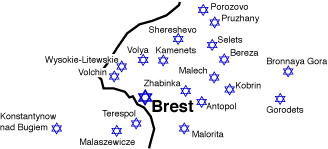
On a group tour of ancestral Jewish homeland sites that had been crushed in the Holocaust, she makes a riveting detour to her grandmother's village of Volchin (20.6 miles NW of Brest), in what is now Belarus, where the last known family members had lived. There, she followed the trail of the death march taken by the village Jews to the place of their slaughter by Nazis and Nazi collaborators in the fall of 1942. During the same period, in Brona Gora, a forest between Brest and Minsk, some 50,000 Jews were shot. Simon was in one of the first American groups to visit this little-publicized site.

Bashert, the Yiddish word for fate, guided her through the arduous quest. With translated archival records, she peeled back layers of clues to confront the mystery. This story of her momentous odyssey reveals the terrible fate of her kin.

Mass shootings of Jews, particularly in the Soviet Union, have not been addressed with the same focus given to concentration camp atrocities. Yet Simon's research reveals that Nazis killed nearly fifty percent of their Jewish victims by means other than gassing. In the historiography of the era, comparatively scant reference is made to the executions at Brona Gora. Thus Simon fills a significant gap in Holocaust history by providing an extensive report on the executions at Brona Gora and Volchin.

As she interweaves tragic narrative with evocative family anecdotes, Simon writes a story of life in czarist Russia and, within this frame, of her family's flight from pogroms and persecution. From a unique vantage Simon's memoir discloses her dogged genealogical search, the Jewish history she uncovered, and the ramifications of the Holocaust in the postwar generation.

Andrea Simon is a freelance writer and photographer in New York City.

FOLLOWS ARE EXCERPTS FROM
Bashert: A Granddaughter's Holocaust Quest
THAT PERTAINS TO BREST-LIVOVSK

Jewish Population and Establishment of Ghetto

Statistics for the city of Brest, October 1, 1936, reveal the total population of 51,170, including 21,518 for the Jews -- over 40 percent of the total. By the start of the war, Brest had about 26,000 Jews; and by the time of the Brest ghetto liquidation on October 15, 1942, the Jewish population included people from the countryside, thus increasing the total to 36,000.

Though the Germans had invaded the city in 1939, it wasn't until their second invasion in the summer of 1941 that the systematic annihilation began. At first, German troops were courteous; but then the SS burst into the city. Posters were placed everywhere ordering all Jews to assemble at the city's main square to receive work orders. Those small numbers of Jews who came were taken to the fort, where they were starved and executed by a firing squad. In the next few days, during door-to-door searches, more men were rounded up and executed in the fort.

On July 12, 1941 (other sources attribute this date to June 28), over 5,000 men, between the ages of 13 to 70, were arrested. Many of these men were educated professionals. An SD squad organized their execution. In November 1941, orders were issued for the creation of the Brest ghetto. On December 16, 1941, all the Brest Jews were forced to live in the ghetto -- actually it was two areas, one small and the other large, separated by the Warsaw-Moscow Highway. Encircled by barbed-wire fences, its three entrances were gated and guarded by round-the-clock Gendarmes. In all, 18,000 Jews were registered.

The German Kommissar Pandikov and Chief of Police Rode (Rohde) were in charge of the ghetto. Like other ghettos, a Judenrat, or special commission of affluent Jews selected by the Germans, was created to keep order. Granted a police force of Jews armed with sticks, the Judenrat was instructed to send the Germans able-bodied workers. At first, Jews had to wear a yellow, six-pointed star. After the creation of the ghetto, this was replaced by a yellow circle, 10 centimeters in diameter. Jews were instructed to wear this on their chest and left shoulder.

Children under 10 years of age did not have to wear the yellow circles. Some of them escaped from the ghetto. They begged for food in the streets of Brest to help feed their families. They were frequently caught, and either beaten or shot.

Despite the Jews' isolation, resistance groups emerged. Some Jews joined a Soviet partisan unit. In the autumn of 1941, the "Freedom" group was formed in Brest, and, in early 1942, another group was created called Nekuma or Revenge, comprised of young people from the Tarbut. Their main goal was to obtain weapons from the Jews who worked inside the well-equipped fort. They devoted the winter to devising the plot, yet the resistance groups were stopped before implementation. With testimony from informers inside the ghetto, the Gestapo arrested several members.

Brest Passport List

"Internal" passports in the Brest archives had been captured by the advancing Soviet troops in 1944. Also captured was a ledger recording the distribution of these passports. It was over 500 pages, created from a census taken by the Germans, containing 12,260 names of Jews over the age of 14 living in the Brest ghetto from November 10, 1941 until June 5, 1942.

Those from the Brest Ghetto List, and about 9,000 children under the age of 14, were transported to Brona Gora, a forest area between Brest and Minsk, and massacred.

Ghetto Liquidation

Sketchy eyewitness reports from Brest and other regional ghettos tell a similar story. On October 15, 1942, awakened at dawn, the Jews were rounded up and surrounded by SS soldiers with dogs. Led to the railway station, the bewildered crowd was loaded onto airless cattle cars -- each car packed with 200 people. By the time they arrived at Brona Gora, 65 miles from Brest, the weakest were already dead.

Brona Gora
(alternate spelling Bronna Gora, Bronnaya Gora)

The official word on the Brona Gora massacre can be obtained from the 1944 report by the "Extraordinary State Commission to Investigate Nazi Crimes Committed on the Territory of the Soviet Union", based primarily on eyewitness testimonies and a special investigation carried out by members of the commission at the site of the mass murders. The Brona Gora massacre site is located 400 meters northwest of the Brona Gora railroad station. In May & June 1942, the Germans began procedures for executions by preparing eight mass graves. They used about 600 - 800 local people a day, as well as explosive materials.

From June to October 1942, 186 railroad cars came to Brona Gora. One of the largest transports arrived in October 1942, containing 28 cars from Brest-Litovsk. As before, surviving passengers were unloaded onto a special platform, surrounded by barbed wire. They were forced to strip -- men, women, and children. Then, through a narrow corridor enclosed by barbed wire, the victims were led to their graves. Each went down a ladder into a pit, lay side-by-side, face down, and had to wait.

When the bottom of the pit was filled up, the Germans shot all of them. Without removing the corpses, they would force more people into the pits on top of the dead. Thus, the pit was filled up layer by layer. While the executions were carried out, the air was filled with screams. In total, from all the actions conducted at Brona Gora, more than 50,000 Jews were killed.

From Liquidation to Liberation

For those left behind in the Brest ghetto, the situation was bleak. Executions continued as the police and Gestapo caught Jews hiding in attics, basements, and other places. The few survivors told their harrowing tales, filled with personal sacrifice and the witnessing of atrocities.

Brest-Litovsk was liberated by the Red Army on July 28, 1944 when about 10 Jews, who had been hiding, were discovered.


If your Jewish ancestors were born, died, married or emigrated from any Shtetl within 50 miles of Brest-Litovsk (in either Belarus, Poland or Ukraine) or you have an interest in the Jews of Brest-Litovsk, the below listed groups are ready to help you with information and research leads. Join all of them today!
Brest, Belarus Research SIG

To join, click on the above "Brest, Belarus Research SIG" and send an e-mail with the word JOIN in the Subject Area.
This discussion group is a forum for researchers with Jewish family roots in the
Shtetl of Brest and the Shtetls within a fifty (50) mile radius.

Belarus SIG Discussion Group
This discussion group is a forum for researchers with Jewish family roots in the country now known as Belarus.
JewishGen Discussion Group
This discussion group is a forum for researchers with Jewish family roots in every country of the world.


HELP PLEASE!

Send us an e-mail telling us what additional information you would like included on this page or if you find any broken links!

Click here to contact the webmaster
through e-mail

We would love to hear your feedback about this, YOUR web site!
Go to the bottom left hand corner and just click on the mail box.

E-mail us by clicking on the above mail box with your comments and suggestions
  • You are the visitor to this web site since December 3, 2004
  • © 2004 ~ Last updated December 3, 2004
  • To send the webmaster an e-mail click here.
  • This is a web page for Brest-Litovsk, Russia (Brest, Belarus) Brisk, Brisker, Brestye, Berestov, Brzesc.