[Page 228]
Prior to the organization of the Councils of the Lands, Rabbinical courts used to convene at the times when central Polish fairs were held. The courts which convened in Lublin, composed of, among others, a representative of the Lithuanian Jews, the Av-Beit-Din ( president of court) of Brisk. In the 80' of the 16th century, when the Council of 4 Lands and Council of 5 Lands started to organize, Lithuania was represented by Heads of States and the Av-Beit-Din of the community of Brisk.
In the year 1607, Rabbi Yehuda, son of Ovadia Ailenberg, mentioned above, who was Rosh Yeshiva (Head of Yeshiva) and the Av-Beit-Din of Brisk, signed the regulations of 4 Lands. In year 1640, at the fair of Yaroslav, an announcement was published, signed by 30 Rabbis, against buying the Rabbinate from the gentiles. Among those who signed it, were only two Rabbis from Lithuania, both of Brisk: Rabbi Leib and the above mentioned Rabbi Beinish Lipshitz.
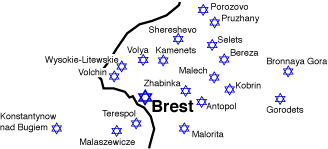
The Jews of Lithuania separated from the Committee of 4 Lands in 1623, and established the Committee of the Land of Lithuania. The community of Brisk kept the first place among the 3 main communities which composed the committee. Out of 45 communities in Lithuania, 30 neighboring communities were under the subjection [jurisdiction?] of the mother community of Brisk. Its authority extended, to the east, to the border of the Land of Moscow, and included Russ area (Minsk, Slutzk and others). To the north, Novogrodek, Slonim and Nieswiez, and to the west Lomza, Amstinov and Visokie-de-Lita.
The importance of the community of Brisk in the Committee of the Land of Lithuania, can be seen, for example, in the decision taken that the regulations of Brisk will be used as a model for the whole state and other main communities. The committee determined, in 1623, that the Jewish custom-collectors in Lithuania, must act the same way as the custom-collector of Brisk, and that they were forbidden to collect higher taxes than the collector of Brisk. The position of the custom-collector of Brisk was so high that it was not possible to sue him in court but in his own town.
The regulations concerning a gentile's prosecution in the court of Brisk were adopted in whole Lithuania. The importance of the Rabbis and heads of land of Brisk was greater or --at least -- equal to the importance of the Rabbis and heads of state of the two other main communities of Pinsk and Grodna.
In 1623, it was determined, out of respect to the aged Rabbi of Brisk, Rabbi Meir, son of Saul Wahl, that the assemblages will take place in Brisk. 19 out of 42 gatherings took place in Brisk and in the communities of the province of Brisk. The Land Committee used to gather once in 4 years, but the Av-Beit-Din of Brisk was given the authority to call for a meeting after 2 years only, if found it right.
During the annual fair in Lublin, which was the central meeting place for the representatives of the Polish Jewry and the Lithuanian representatives, the Committee decided, in the year 1644, that for 6 years, 2 dayanim (judges) from Brisk will reside together with 2 dayanim of Poland, and only later one dayan from Pinsk and one from Grodna will participate. When the regulations of the Land were signed, 1644, the heads of land of Brisk were given the honor of signing first. In 1647, it was decided that the court acting during the fair at Kapolia [Lithuania] will have 2 dayanim from Brisk. As for the third one, he will come, alternatively from Pinsk and from Grodno. Between the meetings of the Committee, 2 paid trustees were in charge. One was permanently from Brisk and the other one alternately from the other 2 main communities.
The importance and central role of Brisk were reflected in the sharing of expenses, taxes etc. In 1639, it was decided to absorb 75 homeless boys. 35 of them were allocated to Brisk and its province. In 1644, the Jewry of Brisk paid a state tax of 270 shok, Lithuanian piastres, a relative large sum compared to other communities. On the other hand, a refund of expenses of 40 Polish Zlotas was given to the representative of Brisk, while the representatives of Pinsk and Grodna got only 35 Polish Zlotas each.
|