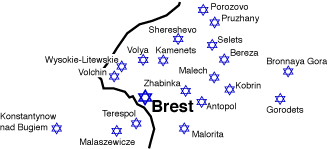
Also: Divin, Drogichin, Khomsk, Malech, Telechany
 |
| Cover design: www.kamenets.by |
 |
| G. S. Musevich photo: O. Medvedevsky |
This book is one of the first modern efforts by individual citizen--historians of Belarus to recover from the destruction of the last 100 years. The Jewish communities of the region are vital parts of this history.
Mr. Musevich is a careful researcher. He depends heavily on eye-witness statements and archival documents. His overriding concern is that this information not be lost forever, as so much of his country's history has been.
The 92-page book is in Russian. It is now in final preparation for printing. The book will be distributed within Belarus only, primarily to libraries, historical organizations, and Belarusian Jewish groups. This is a non-commercial project.
Arrangements for translation to and publication in English are underway.
From the Author's Introduction
In 1500 the Brisk Jewish family Ihelevich purchased a prominent house in Kamenets-Litovsk. This is considered the beginning of the permanent Jewish presence in the town. Historical sources mention Jews among the people setting on the site as early as 1465.
Up until World War II, the Jewish population gradually increased to become dominant in Kamenets-Litovsk and in neighboring Wysokie-Litovosk. Beyond these two towns, Jewish communities could be found in nearby villages -- notably, Volchin, Ryasna, Verhovichy-- in agricultural colonies such as Lotovo, Sarovo, Abramovo, and in many other places in the region.
This people, their unique religion, language, culture, and customs, were not well-understood by those they lived among. And as a result of the development of a racial "theory" by fascist leaders, this people disappeared from our midst.
We can stand on the sidelines of history and choose to not recover the memory of these people and the terrible events of their disappearance. However, those who stand aside condemn themselves and their descendants to a future of unforeseen misfortune and misery.
I myself stand at the threshold of eternity. I cannot, I do not have the right, to keep to myself what I have learned from documents and interview about these people who lived among us. That is why I wrote this book, which I offer to people now living and their descendants...
Working Outline of the Book
1. Preface from the author
2.0 Occupations of the Jews of Kamenets
2.1 In trade, from general sources
2.2 In trade, from Yechezkel Kotik's Book Mayne Zichroynes
2.3 In industries and crafts
2.4 The farming colonies
2.5 Transport as a window into the surrounding world.
2.5.1 The lorry
2.5.2 Balagolas (coachmen)
2.6 Working conditions
2.7 Industries
2.8 Shops
2.9 Restaurants, canteens
2.10 Socio-political life
3.0 Education
3.1 Kamenets-Litovsk
3.2. Regional Schools
3.2.1 Volchyn
3.3.2 Sarovo
3.3.3 Abramovo
3.3.4 Lotovo
3.3.4 Ryasna
3.3.5 Verkhovichi
3.3.6 Vysoko-Litovsk
3.3 General secondary school in Vysoko-Litovsk
3.4 Yeshiva of Kamenets-Litovsk
3.5 The prominent teachers of Kamenets Yeshiva
3.6 Kamenets Yeshiva of America: the impact of Boruch Ber Liebowitz
4.0 Kehila (community) life
4.1 Kehila life in Kamenets-Litovsk
4.2 Kehila Council in Vysoko-Litovsk in 1936
5.0 Religion, synagogues, cemeteries
5.1 Religion
5.2 Synagogues
5.3 Cemeteries
5.4 Discovered matsevas (grave stones)
5.5 Rabbis, cantors of Kamenets-Litovsk
6. Jewish culture in Kamenets-Litovsk
6.1 Libraries
6.2 Drama circles
6.3 Writers, poets
6.4 Scholars
6.5 Pastimes
7. Where Jews lived in Kamenets District
8. The professions of the Jews of Kamenets-Litovsk
9. Kamenets street names, old and new
10. Bazaar and fair days in Kamenets-Litovsk
11. Yechezkel Kotik about Kamenets-Litovsk, extracts
12. Coming of the Red Army
13. Coming of Hitlerites
13.1. War outbreak, the death of a Jewish lady
13.2 First shootings of Jews
13.3 Deportation of Jews to Pruzhany and their return
13.4 Ghetto in Kamenets-Litovsk
14. Dora Galpern's life-story
14.1 Recollections about the drastic days
14.2 Ghetto
14.3 Ordeals, courage and escape from the torturers
14.5 Liberation
14.5 From frying pan into fire
14.6 in the Soviet jail
14.7 Court
14.8 Back in the jail
14.9 The end of the ordeals
14.10 Author's comments
15. Transportation of the Jewish men to work
16. Liquidation of the ghetto
17. My trip of Kamenets
18. The open letter to Kamenets District Council
19. Return to hearth and home
20. The names of Jews in Kamenets-Litovsk
21. Concluding remarks
Section 5.3 -- Cemeteries [Rough Translation]
Not all towns with Jewish populations included Jewish cemeteries. There were no Jewish cemeteries in Lotovo, Sarov, Abramov; their dead were taken for burial to Kamenets-Litovsk. It has been impossible so far to locate a Jewish Cemetery in Verhovichah. Volchin is known to have had a Jewish cemetery, but it cannot be precisely located. Ryasne resident Anonina Plisun told us, "The Jewish cemetery was located north of the marketplace, on the other side of the Kamanets-Litovsk highway. Resident Anna Musevich tells of the Wysokie-Litewskie (now Vysokoye) Jewish cemetery: "It was on the hill, east of the current House of Culture, in front of the mill on Wyganow Street (now Sovietskaya Street)". A second Jewish cemetery there was located by the local college directory, Yuri Saharchuk. It is located at the outskirts of Wysokie-Litewskie, near the current site of the agricultural college. Kamenets-Litovsk had three Jewish cemeteries: The oldest was located on Brest Street. There is now a branch of the Agroprombank there, according to Kamenets-Litovsk resident Yaroslav Mushitsa. The old cemetery, Kvores, dating from the 18th century, was also located A new cemetery is located 200 meters from Shossova St., now 8th of March St., in a newly planted forest area and ["Santehspetsmontazh."?] These three cemeteries were razed and few traces remain. [????] The tombstones were taken away and used as grinding stones, for paving roads, and as steps. |