Table of Contents
(?)
Site Page Counts
Public: 510
Restricted: 677
//add in logic required to do stories on each page
require_once './include/story_page_include.php';
include "./include/story_page_nav.php"
?>
This is what Shmuel Englander told me about the Soviet occupation of Volchin:
[After the Nazis departed:] Soon, as agreed by the
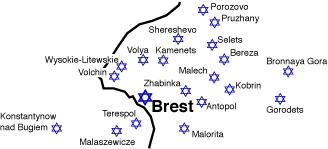
Molotov-Ribbentrop Pact, the Nazis left. The Soviets took over the area now called Belarus, westward as far as the Bug River. On the other side of the Bug, the Nazis ruled over the Polish territory they had just conquered. At the beginning, the Soviets treated the Jews of Volchin neutrally. They allowed the synagogue to continue normally. Few of the Russians were anti-religion. Only the
politicians were anti-religious but at the beginning they did nothinh
Then an instruction came from Moscow and they stopped the activity of the synagogue. The holy articles were removed and the building became a hall for public events with Soviet-Communist nature. All of Volchin's inhabitants, including the young Jews, turned the building into a dance-club encouraged by the Soviet Union authorities. From time to time assemblies were carried there and the
politicians gave speeches.
The Soviets nationalized all Jewish business places, including the bakery of Yitzchak Englander's bakery, the Kupershmit Shenk, the tavern-bar; and my grandfather Rachmil Stavsky's hardware store. The bakery provided bread for the Russian army. The Englanders even convinced the Russians to let them continue to run bakery even though they were no longer the owners.
Instructions from Moscow now forbade bourgeois citizens from living within 50km of the border. Volchin was about 10km from the border, the Bug River. Accordingly, the richest man in Volchin, Sobelman, was forced to a settlement further from the border somewhere by the Soviets.
Later, during the German occupation, as we heard in 1997, they returned and were placed in the Volchin Ghetto.
At about this time, my grandfather Yerachmiel Stavsky sent a postcard to my mother and aunt in Israel, describing the conditions in Volchin and nearby Wysokie Litewskie.
It was the end of summer. Rain did not fall abundantly then. In order to combat the expected mud in winter, my grandfather paid half the price of boots for his son, ordered from the shoemaker in W-L. The price of the boots was 900 rubles (3 months pay).
My aunt Minnie was still unmarried and was living in her father's (Rachmil's) house, in Volchin. She fell ill with the flu and was “hospitalized” in Wysokie Litewskie until she recovered.
//add in logic required to do stories on each page
require_once './include/story_page_include.php';
include "./include/story_page_nav.php"
?>
| Editor's Notes: politicians -- probably: Soviet political officials, commissars, комиссары. |