Table of Contents
(?)
Site Page Counts
Public: 510
Restricted: 677
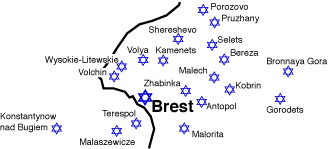
Moshe was born to the Stavski family in Antopol, Russia, in 1884. He wrote in Yiddish, moved to Warsaw in 1907 and gradually started writing in Hebrew and became a well known story write in Eretz Israel. In 1911 – made Aliya to Israel (then Palestine) and worked as a clerk, as a farmer, with the cows, as a guard and was the head of the Workers Union in Petach Tikva, etc. Between 1930 and 1932 he was sent to Poland to give a boost to Hebrew Literature. In 1952 he published The Eve of Day which is a collection of stories and memories of the shtetl Antopole.
Around 1930 he visited Volchin. At that point, my grandfather Rachmil Stavsky, issued him a Polish ID card, which could be used to get an exemption from military service.
Moshe described my grandfather in his memoirs.
Moshe described him as a very tall and sturdy man with a
black beard. Rachmil was neither tall or black-bearded; he was a red-head...
Moshe, a literary man, also wrote about this incident: At some point he met two men in Brisk whose name was Stavski. They
told him that the source of the family name is in the place called
Stavski, north of Bialystok. They said that Stavski derives from
the word Stavi, a small lake. The locals of that place near the lake
changed their name 200 yrs ago into Stavski. There was one Jewish
family there and they did the same. All the Stavskis in the world are
from that family. But the story about these two men was certainly distorted or completely imaginary.
In contrast, Moshe wrote about getting the ID card without mentioning the name of his kinsman who issued it.
Moshe later changed his name in Hebrew to Stavi, which he used to sign his literary works.