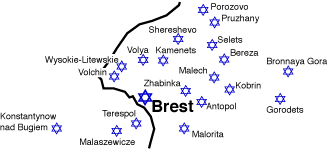
Also: Divin, Drogichin, Khomsk, Malech, Telechany
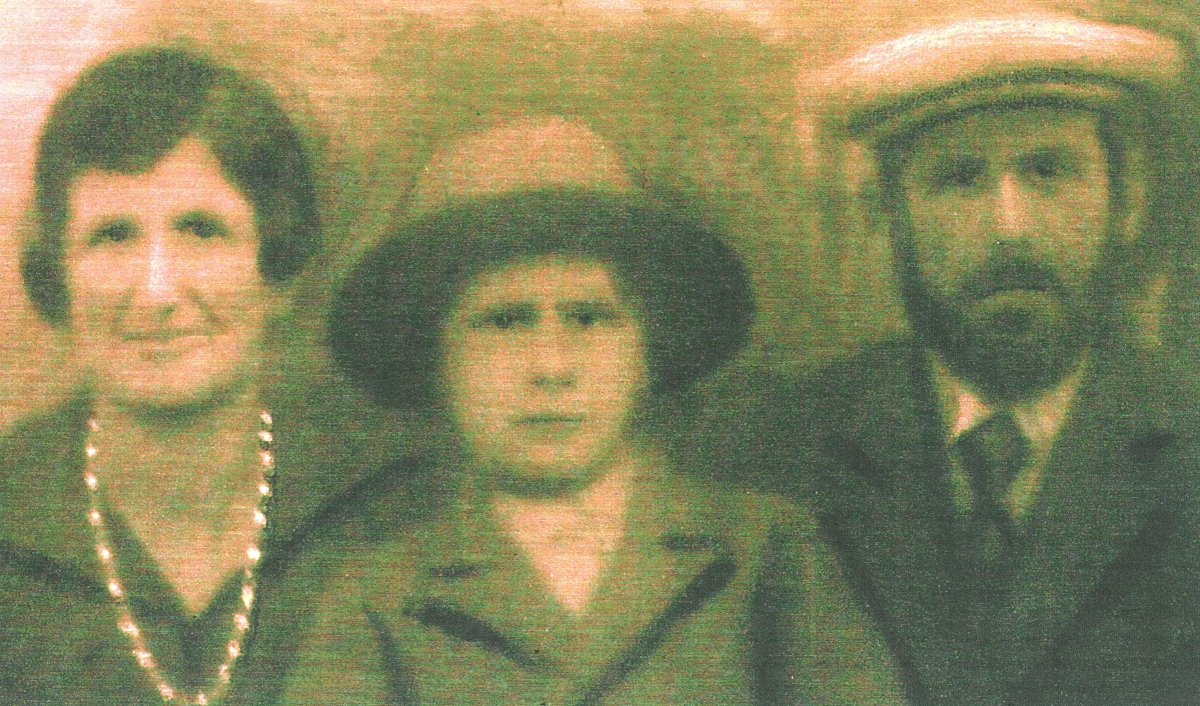 |
| Rachmil/Yerachmiel Stavsky (right) Wife Mindl (left) and son Berl (center). About 1930. |
Rachmil was the life-guard of Volchin. Whenever a person was in trouble in the water they would call him to help. If the person had disappeared, my grandfather would take a loaf of bread and throw it into the water. Then he would follow the direction the loaf was swept away, jump into that place to pull out the victim.
Rachmil and his family kept a home dairy farm.
He had a franchise from the government of
Poland to register the Jews of Volchin and neighborhood – births,
deaths, and issuing of formal IDs with a government stamp.
He was paid for that, of course, by his customers, and part of the fee he
passed to the government. My grandparent issued a Polish ID cards to Moshe Stavsky when he came for a homeland visit from Eretz Israel in 1930.
My
grandfather often spoke in terms of biblical stories. He was a Chazan (cantor) in the Volchin synagogue and read from the Torah. My
mother adored and worshipped him. She tried to pass this admiration on to me and my siblings.
Rachmil often spoke in a Ipcha Mistabra manner (“on the contrary, the opposite of”). He often used Bible quotes, sayings, proverbs, and jokes in his speech. Rachmil took advantage of that linguistic talent, understood by my mother Tema and my aunt Nechama, to circumvent the Soviet Censor. His sayings, as recounted by my mother, a skilled imitator, included: ver lacht azoy Drekish [=who laughs so “shittish”]. …
Remembering my Grandfather
My famiily made aliya to Eretz Israel at the end of 1929, when I was two-and-half years old: That was the last time we saw him but he stayed in my consciousness as my mother who never stopped talking about him, miss his wisdom, his sayings, and his use of Ipcha Mistabra language. He was a public figure in Volchin, reader from the Torah in the synagogue and a Chazan (cantor). He would read the Esther Megilah on Purim to the joyous cries of the children. People revered him in Volchin and honored him by giving him a seat next to the Eastern Wall of the Synagogue (Kotel Hamizrach).
Today, the local council house is built on the land that belonged to my grandfather Rachmil (Yerachmiel) Stavsky. For its construction they used the silicate bricks that were taken from the ruins of my grandfather's house on that site. [View photos of the site, here.]
Previously, the family had lived in a wooden house on a different site. It started sinking in the earth and the ceiling was almost hitting the heads of the family. So Rachmil built the new house of silicate bricks. A Gentile bought the old wooden house, dismantled it, and rebuilt it in his nearby village of Dubovie.
The goyim called me Rachmilevich because I was the offspring of Yerachmiel.
My grandfather told me he was left-handed but they hit him on the hand so that he was forced to use his right hand for writing. I, my wife, and one daughter – we are left-handed.
| Editor's Notes: It seems that the iron shops of father Shevach (in Wysokie Litewskie) and son Rachmil (in Volchin) were similiar in terms of stock and trade, except that Rachmil was not known to function as a moneylender. Plows: By far, it seems, non-Jews would have required plows. Jews typically kept only gardens. |